Singapore Bullion Market Association

Article List

Article List

The growth of Derivatives and the Case for Regional Metals Markets

By RUSSELL ROBERTSON, Chief Business Development Officer, Abaxx Exchange and Clearing
The evolution of derivatives markets represents one of the most important developments in industrial risk management, transforming localised basis risk into globally integrated systems of price discovery, hedging, and capital flows.
These instruments are not merely speculative tools but an essential means for any business exposed to commodity markets to manage price risk.

The History of Derivatives

The origins of futures trading can be traced back to 1634 with the Dutch “Tulip mania”, when bulb prices soared to extraordinary heights before collapsing in 1637 – arguably the first recorded pricing bubble and the first noted use of financial “forward contracts”.

the origins of futures trading can be tracked back to 1634 with the dutch “tulip mania”
By the late 20th century, derivatives markets had expanded well beyond agricultural commodities into instruments such as interest rates, foreign exchange, energy and metals.
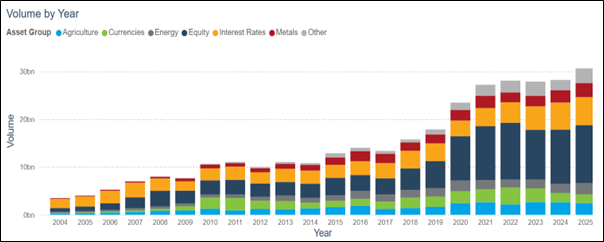
Data from the Futures Industry Association (FIA) illustrates the significant growth of derivatives instruments (futures and options) until a recent dip caused by regulatory changes in the Indian financial markets that cut total options market volume by 58% year on year.
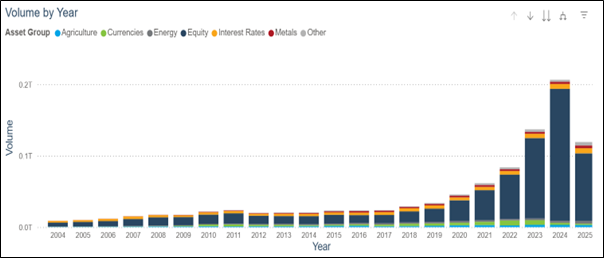
Looking at global futures contracts in isolation, the picture is unambiguously positive: a continued uptrend of 9% year on year with no regulatory headwind.
Fig.1: Volume by Year for global derivatives (Futures and Options). Data: FIA.
Fig.2: Volume by Year for global derivatives (Futures Only). Data: FIA.

Supply and Demand Fundamentals

Supply and demand fundamentals are the baseline for price discovery in any commodity market: the more plentiful a good, the lower its price should be in theory.
A review of metals supply and demand over the past five years reveals several developments that have shifted market balances, accelerated adoption of precious metals futures and amplified price volatility.
On the demand side, central bank buying has been substantial, and the global push for energy transition and electrification has generated significant demand for silver and base metals. On the supply side, structural tightness has persisted alongside silver ore deficits, affecting both production and logistics. Both supply and demand have been subject to heightened volatility, with geopolitically driven tariffs disrupting commodity flows.
World Gold Council data nevertheless shows that, despite these price swings, the underlying with supply/demand balance for gold has remained broadly stable.
The result is growing trading activity – more buyers and sellers – and a shift in how gold is perceived: less as a traditional industrial commodity and more as an investment instrument. This trend is sometimes described as “futurisation”.

Price Correlation and Regional Focus

These supply and demand dynamics have marked a structural inflection point in markets, characterised by the convergence of macroeconomic and geopolitical uncertainty, new technological demand drivers and shifting commodity flows.
Trading activity across metals futures and options surged to record 3.8 billion contracts in 2025 and up 24% year on year – the largest annual increase since the US Dodd-Frank act changed regulations to move swaps to futures in 2007-2008.

Gold Futures Contracts Traded per Year
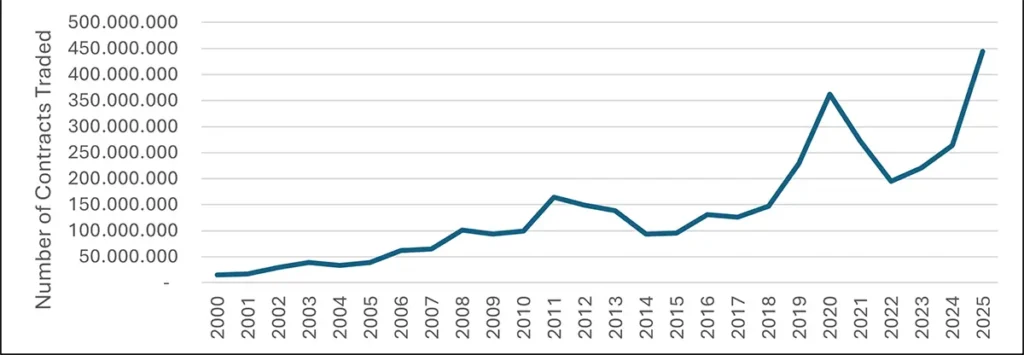
Fig.3: Gold Futures traded volume. Data: FIA.

As participation in precious metals markets grows and price volatility persists, the case for regional trading hubs and localised price discovery becomes compelling. There is a clear need to capture the price of gold at its point of consumption – not just at financial hubs such as London and New York, where the physical bars in question may never have traded.

Abaxx Exchange and Clearing listed a Singapore physically delivered 1 kg gold futures contract on 12 June 2025, giving participants a means to manage price risk on kilobars in Singapore, with the option of physical delivery to a Brinks vault in Singapore. Bars delivered to the vault are not subject to GST unless removed domestically, and must meet LBMA good delivery standards.
By focusing on physically deliverable contracts and integrating modern clearing technologies, Abaxx aims to bridge the gap between physical and financial markets, enhancing price transparency, efficiency, and capital utilisation.
Bloomberg data shows that even where prices vary by region, sufficient correlation exists to allow participants to hedge specific regional exposures as part of their commercial operations or institutional investment opportunities. Adopting such risk management practices provides meaningful protection against the impact of regional geopolitical developments.

Gold Derivatives Portfolio End of Day Settlments
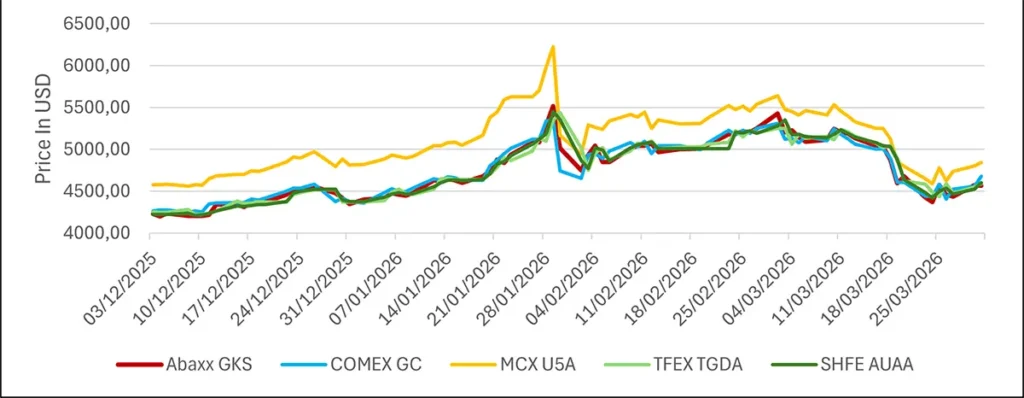
Fig. 5: Data: FIA.

As the geopolitical landscape shifts and attention turns increasingly to regional commodity pricing, FIA data confirms significant volume growth in Asia-based metals trading.
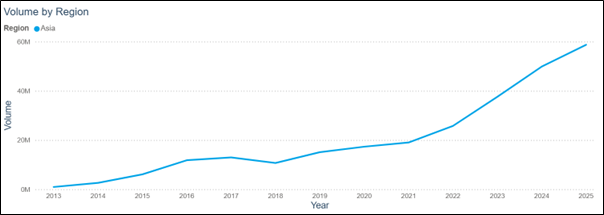
Fig. 5: Asia metals trading volume. Data: FIA.

Conclusion

From tulips to algorithmic-driven futures markets, derivatives have evolved into one of the most important pillars of global finance. The events of the last five years have transformed the metals market: metal products are no longer peripheral commodities but central inputs to the global economic transition and, increasingly, benchmarks for economic performance.
Initiatives such as Abaxx, alongside MAS-led programmes including Project Guardian and Project Lion, are advancing this evolution – underscoring Singapore’s commitment to integrating digital assets and financial infrastructure as a foundation for next-generation market structure.
The metals futures market is no longer just about hedging risk. It is about pricing the future of the global economy itself.
Based in Singapore, Russell joined Abaxx Exchange and Clearing in September 2025 as Chief Business Development Officer. Russell is a seasoned executive with over 25 years of experience in financial markets across the full trade life cycle from trading to clearing. He has deep knowledge of derivative markets from key roles as a senior multi-asset proprietary trader, operational product development at CME Group in London and Clearing technology with ICE Clear Europe. He was previously chief commercial officer at the Gulf Mercantile Exchange since 2019, where he oversaw the commercial business and the management of the Oman crude oil derivatives market and East of Suez benchmark pricing.