Singapore Bullion Market Association

Article List

Article List

DIGITAL GOLD IN SOUTHEAST ASIA

By TAN KWAY GUAN, Central Banks and Public Policy Lead (Singapore), World Gold Council

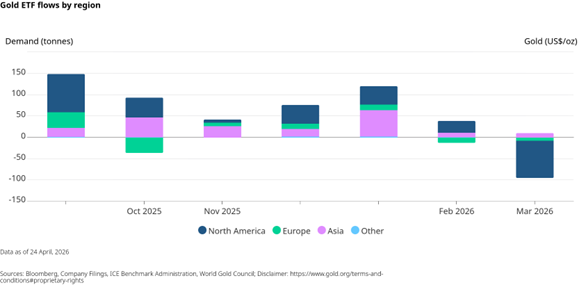
Gold had a standout year in 2025 with both gold demand and price reaching record highs, with investment demand being a major driver. Global Investment demand for gold in 2025 reached 2175.3 tonnes, up 83.5% from the 1185.4 tonnes in 2024. While Q1 2026 has seen some outflows in Western markets, Asian demand remains strong. The World Gold Council expects demand to remain strong through 2026 on the back of geopolitical factors driving central bank demand, broad global ETF inflows and bar and coin accumulation.
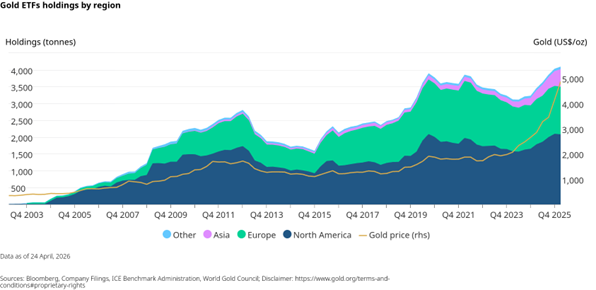
In terms of methods for accessing gold, gold ETFs have grown to become an increasingly popular channel globally. While the bulk of gold ETF holdings remains in North America and Europe, the share of global gold ETF holdings in Asia has notably grown in recent years. This trend towards gold ETFs in Asia is expected to remain resilient: even as sell-offs were observed in other regions in March 2026, Asia continued to see inflows to gold ETFs.

Gold ETFs Holdings by Region

Sources: Bloomberg, Company Filings, ICE Benchmark Administration, World Gold Council; Disclaimer: https://www.gold.org/terms-and-conditions#proprietary-rights

Gold ETFs Flows by Region

Sources: Bloomberg, Company Filings, ICE Benchmark Administration, World Gold Council; Disclaimer: https://www.gold.org/terms-and-conditions#proprietary-rights
Beyond ETFs, digital gold also encompasses digital gold accounts and gold tokens, which are a fast-growing segment. These digital gold formats enable investors to overcome traditional issues associated with physical gold such as larger minimums, offline buying, exchange fees and storage. Digital gold products do this by:
  • Making it easy to start and continue investing (e.g., small minimums, recurring buys, simple portfolio placement).
  • Offering the right format for different needs (e.g., ETF-like exposure, vaulted accounts, tokenised products).
  • Building confidence with clear pricing, clear custody and audit information, and simple rules for selling or taking delivery.
Done right, digital gold enables ease of access to gold investments for a wider range of investors particularly among younger retail investors.

South east Asia’s Market Potential

The economies of Southeast Asia (SEA) present a clear opportunity for digital gold products. SEA is a region with a growing population of approximately 695.3 million people. It comprises mainly middle-income countries with the exception of Singapore which is high-income. Annual GDP per capita ranged from $1,332 to $90,674 in 2024.1,2 The region is set to continue its strong growth, despite the global economy facing headwinds stemming from increased geopolitical risks. In April 2026, the International Monetary Fund (IMF) revised its global growth forecast for 2026 down from 3.3% to 3.1%.3 While also expected to slow, SEA remains a bright spot: the ASEAN+3 Macroeconomic Research Office expects ASEAN-10 to grow at 4.6% in 2026, beating global growth.4, 5 Inflation is also expected to rise both globally and in SEA. The IMF projects global inflation at 4.4% for 2026. Against this backdrop, the outlook for gold investments in SEA is positive as the growing pool of investors in the region seek effective hedges.
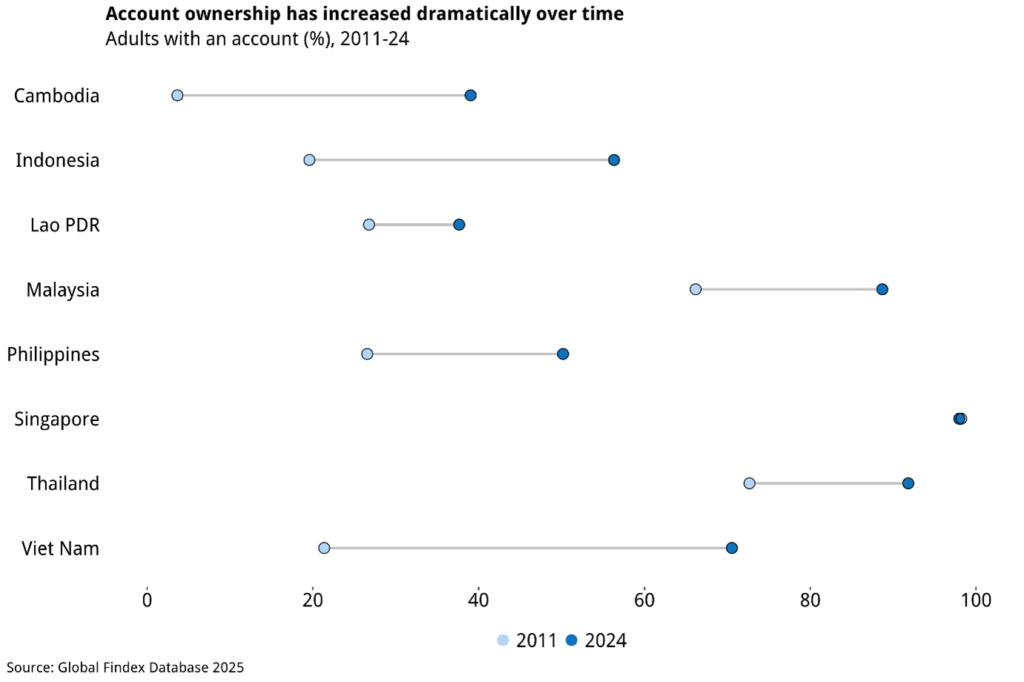
In tandem with this economic development, SEA is becoming increasingly digitally savvy. The pace of digitalisation has been accelerating, with ownership of digital finance accounts having grown dramatically over time across the region.6 Digital wealth in the ASEAN-10 economies is reaching scale with total AUM of approximately $90 billion and projected to reach $410 billion to $457 billion by 2030. Digital platforms have been aggressively acquiring customers and competing with traditional banks to serve the underbanked. Finance apps as a share of app downloads in SEA grew from 6% to 12%, outpacing many emerging and mature economies.7 All this speaks to a rapidly growing pool of retail investors with growing incomes for which digital gold products would be an attractive means to access gold as an investment product.
Government support for gold as an investment product is also growing in the region. In recent years, several regional governments have announced policies to grow and develop the gold industry in their respective countries. Notable initiatives include Indonesia, one of the world’s largest gold exporters, which launched its “2026–2031 Roadmap for the Development and Strengthening of Bullion Business Activities and Ecosystems”. Through this roadmap, Indonesia is looking to strengthen its national bullion system and further deepen its financial market including the development of gold ETFs.8
Lao PDR, another SEA economy with gold reserves, has also launched the Lao Bullion Bank with the mandate to “accumulate gold to ensure stability and create financial and treasury liquidity, guarantee the value of the Kip currency at a stable level, and contribute to raising Lao industrial standards up to international standards, increasing the value of resources to maximise value and benefits, and create economic stability for Laos”.9 The Lao Bullion Bank has indicated that it has ambitions to provide digital platforms for gold trading. Government support for gold as an investment product is also growing in the region. In recent years, several regional governments have announced policies to grow and develop the gold industry in their respective countries. Notable initiatives include Indonesia, one of the world’s largest gold exporters, which launched its “2026–2031 Roadmap for the Development and Strengthening of Bullion Business Activities and Ecosystems”. Through this roadmap, Indonesia is looking to strengthen its national bullion system and further deepen its financial market including the development of gold ETFs.8
Singapore, already an international hub for gold trading, has also announced the formation of a Gold Market Development Working Group to strengthen the country’s position as a trusted gold trading centre serving the Asia-Pacific region. Key focus areas include developing gold-related capital market products to facilitate price discovery and build liquidity, putting in place robust and internationally-aligned standards for vaulting and logistics, and building a Singapore-based clearing system to support secure and efficient OTC settlement for trading large bar and kilobar gold in Singapore.
Collectively, these broad trends and developments in SEA speak to a burgeoning gold market geared towards digitally enabled solutions and products.

Account Ownership Has Increassed Dramatically Over Time Adult With an Account (%), 2011-24
Sources: Global Findex Database 2025

Potential Challenges

While SEA is a promising market for digital gold, there remain some challenges inherent to digital gold products and the region that should be addressed. Digital gold products are highly fragmented with individual providers building stand-alone infrastructure. This fragmentation creates a series of issues. Firstly, gold’s liquidity and fungibility are key properties that make gold attractive as an investment instrument. The fragmentation of digital gold infrastructure globally exposes investors to differences in custody structures, regulatory standards, audit standards and processes across products. The consequence is that digital gold is often not interchangeable and cannot move across platforms, limiting the financial usefulness of the product.
Second, investors are exposed to trust and transparency concerns as there is a lack of systemic mechanisms to ensure that the products are fully backed by physical gold, secure in stress scenarios and properly audited. Being digital in nature also adds a layer of cybersecurity risk. Users often need to independently assess products, which weakens trust in them. To address these issues and others, the World Gold Council has published a white paper which presents the case for shared infrastructure for digital gold and introduces the Gold as a Service concept being developed.10
Domestically, the digital financial literacy levels of the population remain a key issue. Research by the OECD finds digital financial literacy to be lagging in several SEA countries.11 This presents a strong impediment to the uptake of digital gold investments. Regional governments have recognised this as a key policy issue to be addressed and are actively partnering internationally to improve digital financial literacy.12
1 SEA here comprises Brunei Darussalam, Cambodia, Indonesia, Lao PDR, Malaysia, Myanmar, Philippines, Singapore, Thailand, Viet Nam and Timor LesteDespite these challenges, Indonesia’s direction is clear. With strong policy support from OJK, growing industry participation, and infrastructure innovation such as ATM Gold, the country is well-positioned to unlock the full potential of its gold market.
4 ASEAN-10 comprises Brunei Darussalam, Cambodia, Indonesia, Lao PDR, Malaysia, Myanmar, Philippines, Singapore, Thailand and Viet Nam
5 ASEAN+3 Macroeconomic Research Office. 2026. ASEAN+3 Regional Economic Outlook 2026
6 The World Bank. Global Findex Database 2025
7 Google, Temasek and Bain. e-Conomy SEA 2025
TAN KWAY GUAN, joined the World Gold Council as Central Banks and Public Policy Lead, Singapore in 2025. Previously, he was a research associate and principal project Manager at the Asia Competitiveness Institute, Lee Kuan Yew School of Public Policy, where he led development economics research and public policy advisory for ASEAN governments. Kway Guan authored multiple publications on development economics, international trade, public policy and applied econometrics .