Singapore Bullion Market Association

Article List

Article List

Why tokenisation Matters for the Bullion Industry and How Carrying Costs Fit In

By EVA MENG, Head of Matrixdock

Gold has served as the foundation of financial trust for centuries, not by convention, but by consensus. Governments, institutions, and individuals across every era have independently arrived at the same conclusion: gold holds.
Consensus alone does not determine what an asset can do. It only determines where trust begins. The history of financial innovation is not about creating new assets; it is about making existing ones more accessible, more liquid, and more useful. The printing press did not invent money. Electronic trading did not invent equities. Each innovation rewired what already existed, and in doing so unlocked value that was always there but could not move. Tokenisation works the same way.
This is why asset selection matters more than technology. A real-world asset (RWA) token derives its value from the asset beneath it. Sovereign debt has been among the earliest assets to see adoption in tokenisation: the most liquid, most institutionally understood instrument in global finance. Gold followed naturally: centuries of cross-border consensus, deep physical markets, and a role that every class of institutional investor already understands.

What ETFs Did and What Tokens Can Do Next

But gold ETFs were primarily designed to provide exposure. They were not intended to make gold directly usable across financial operations such as settlement or collateralisation. Instead, gold held through ETFs is accessed via fund shares and generally remains within the fund structure. This was a deliberate design choice that was entirely appropriate for the infrastructure of that era.
That infrastructure is now changing. As settlement systems modernise and programmable finance develops, the question is no longer only who can own gold but what gold can do. Can it settle a transaction instantly? Can it serve as collateral across borders without an intermediary? Can it move through financial systems as deep, widely recognised liquidity? ETFs cannot meet these demands, not because they failed, but because they were never asked to.
This is the generational shift. Gold ETFs financialised gold and brought it into portfolios. Tokenisation is designed to enable broader operational use, potentially allowing gold to be used within certain digital financial infrastructures. Gold tokens do not change what gold is. They change where gold sits in the financial system. For the precious metals industry, this means gold is moving from a passively held asset to an active one: the same gold, with a broader range of potential applications: 24/7 trading, fractional access, cross-border settlement, digital collateral, and B2B payment rails. All without leaving the LBMA-accredited supply chain.

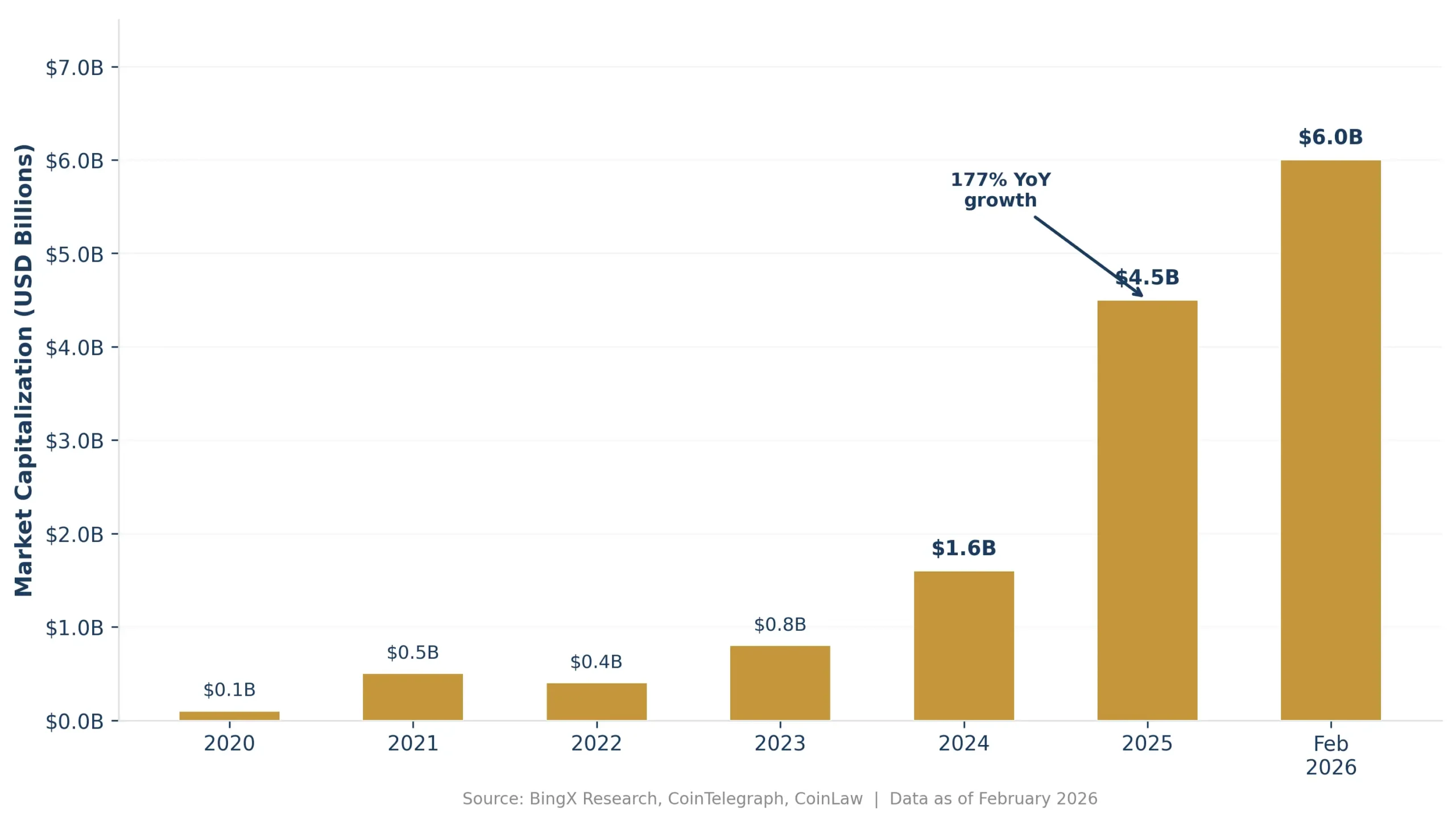
Tokenised Gold: Market Cap Growth

Figure 1: Tokenised gold market capitalisation, 2020–2026.
The numbers bear this out. The tokenised gold market surpassed $6 billion in market capitalisation in February 2026, having grown 177% year-on-year in 2025. Trading volume reached $178 billion, surpassing all but one U.S.-listed gold ETF. Over 115,000 new wallets were added during the year, nearly tripling the holder base. These are not speculative numbers. They reflect a structural migration of precious metals into programmable digital infrastructure.

The Carrying Cost Challenge and a Silver Solution

While gold’s storage costs are relatively modest, silver presents a different economic profile. Silver is bulkier per unit of value, requiring significantly more vault space, higher insurance premiums, and greater logistics overhead. These carrying costs are a defining feature of physical silver ownership and any honest tokenisation of the metal must account for them.
ETFs have long handled this through annual expense ratios. The SPDR Gold Trust (GLD) charges 0.40% per year; the iShares Silver Trust (SLV) charges 0.50%. These ratios are deducted from fund assets daily: metal is periodically sold to cover expenses, so the metal backing per share decreases over time while the share count stays constant. It is an elegant mechanism but it blends genuine custody costs with centralised management fees and profit margins, making it difficult for holders to distinguish what they are actually paying for.
The Fungible Reserve Standard (FRS), published in March 2026 on Social Science Research Network (SSRN), offers a new approach designed specifically for assets where carrying costs are material. Rather than embedding these costs within a broader fee structure, FRS encodes them transparently into the token’s on-chain logic through a variable called q(t):the asset-per-token ratio, which decreases over time at a predefined annualised rate. Functionally, this is analogous to an ETF’s declining metal-per-share ratio, but with one key distinction: FRS isolates pure carrying costs (vaulting fees) from management fees and profit margins. What the holder sees on-chain is the actual cost of custody, not a bundled figure that obscures the issuer’s economics.

Carrying Costs:
Precious Metal ETFs vs. FRS-Based Tokens
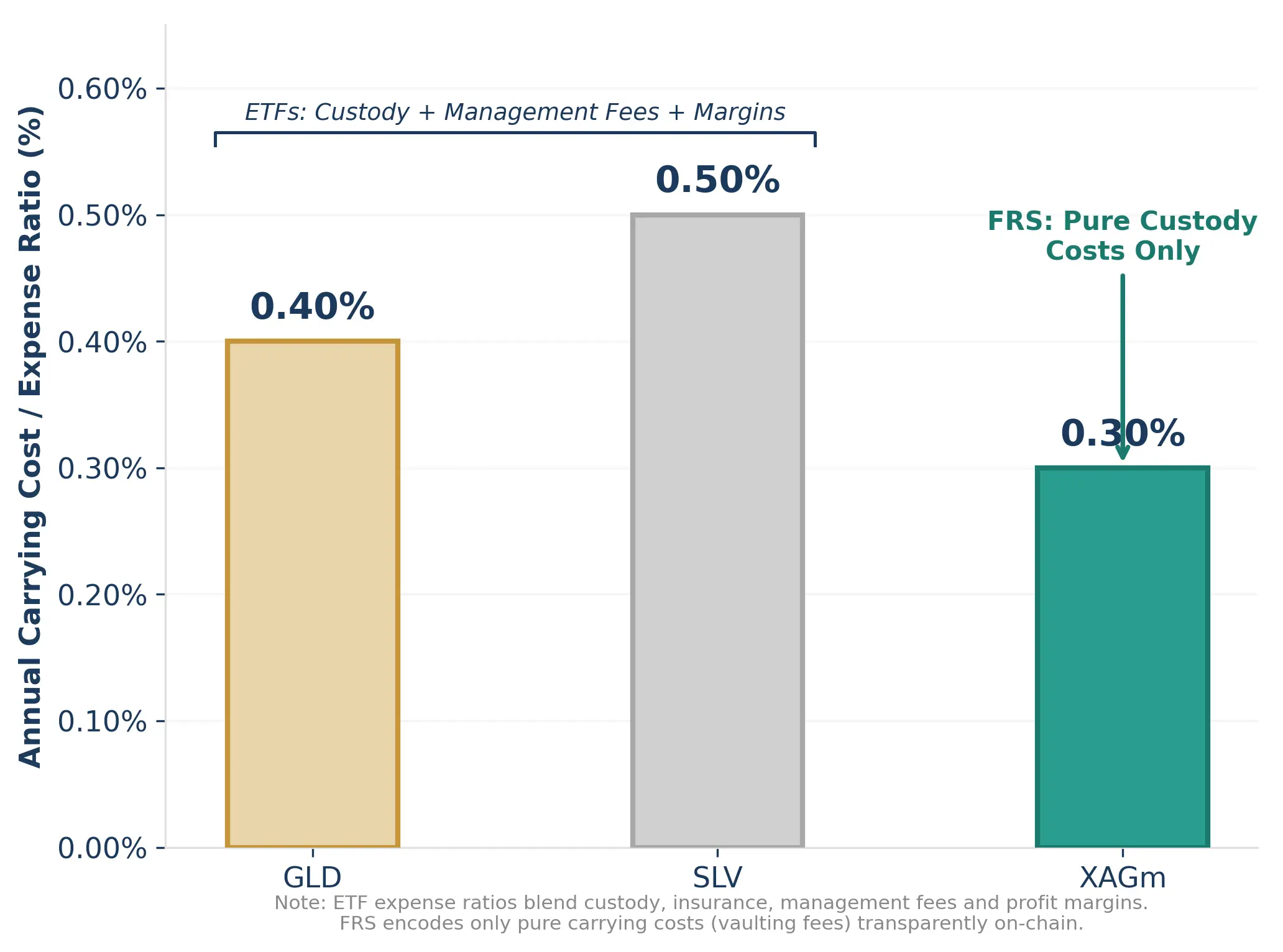
Figure 2: Annual expense ratios of GLD and SLV compared with the FRS-based XAGm carrying cost rate.

The framework is built on what it calls the Economic Purity Principle: the token must faithfully represent the underlying asset’s economic characteristics, including its negative carry, rather than masking or transforming them. FRS preserves full compatibility with digital financial markets, where tokens built on it are designed to function in lending, trading, and collateral applications without requiring wrappers or rebasing that fragmented liquidity. It is asset-agnostic: applicable to any physical asset with predictable holding costs, from silver to platinum to warehoused commodities.

How Carrying Costs Are Encoded: FRS q(t) Mechanism)
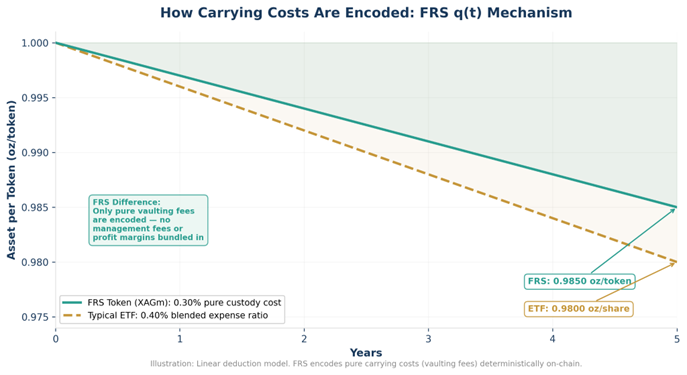
Figure 3: The FRS q(t) mechanism — asset per token declines at a transparent, predetermined custody cost rate.

From Theory to Practice

Matrixdock’s XAGm, launched in March 2026, is the first tokenised asset built on the FRS framework. Each token is backed by fully allocated LBMA Good Delivery silver bars held in institutional-grade vaults. At launch, one XAGm equals one fine troy ounce of silver; over time, the ozPerToken value decreases daily at an annual 0.3% custody rate reflecting the pure cost of vaulting, with no management fee or profit margin layered on top.
XAGm sits alongside Matrixdock’s established gold token, XAUm, which represents one troy ounce of 99.99% pure LBMA-accredited gold, fully allocated and vaulted by Brink’s in Singapore and Hong Kong. XAUm operates with independent physical audits by Bureau Veritas, an LBMA-only supply chain, multi-chain availability across eight networks, and physical redemption in both Singapore and Hong Kong. In April 2026, OSL Group, a licensed Hong Kong digital asset exchange dual-listed both XAUm and XAGm, becoming the first regulated platform in the city to offer simultaneous gold and silver tokens.
The broader trajectory extends beyond commercial products. In December 2025, the Kingdom of Bhutan launched TER (meaning “treasure” in Dzongkha), a sovereign gold-backed token built on Solana with Matrixdock as technology partner. This is one of the first instances of a sovereign state leveraging public blockchain to tokenise national gold reserves.

The Road Ahead

For the precious metals industry, Tokenisation represents something significant: physical assets moving from passive holding to active use. Not replacing their reserve function, but adding a new layer on top of it. The same metal, stored in the same LBMA-accredited vaults, audited by the same independent firms, but now capable of settling instantly, serving as programmable collateral, and participating in digital financial markets that operate around the clock.
Gold was the right place to start. Silver, with its dual role as both a reserve asset and a critical industrial input now reportedly in its fifth consecutive year of structural supply deficit, is the natural next step. As tokenisation matures, the standards the industry adopts will determine whether digital precious metals earn the same trust that physical markets have built over generations. The consensus that built gold’s value over centuries is being put to work, powering its next evolution.
Disclaimer: These materials are provided for general informational purposes only and do not constitute investment advice, financial advice, an offer, solicitation, or recommendation to buy, sell, or hold any digital asset, or to engage in any specific investment strategy. Digital assets involve significant risk, including the potential loss of principal. Individuals should seek independent professional advice before making any investment decision. Matrixdock’s services or products referenced are subject to applicable jurisdictional and regulatory restrictions and may not be available in certain jurisdictions. Physical redemption locations depend on partnering custodian availability and applicable eligibility requirements.

This article is brought to you by SBMA in association with Matrixdock.

Eva Meng is the head of Matrixdock, an RWA tokenisation brand owned by BIT (previously known as Matrixport). Eva is passionate about bridging digital assets and traditional finance and is focused on leading the team to build cutting-edge technology in the tokenization space. Prior to BIT, Eva spent over 6 years in the digital asset mining industry.