Singapore Bullion Market Association

Thailand’s Gold Market at a Turning Point

By TANARAT PASAWONGSE, Chief Executive Officer, Hua Seng Heng Group

Asia is the the heart of the global gold market, driving the majority of physical demand and trading activity. Among the region’s leading markets, Thailand stands out for both its depth and heritage.
Gold has long been embedded in the Thai way of life, valued as a store of wealth, a hedge against uncertainty, and a cultural symbol of prosperity and trust.
Today, Thailand’s gold market is more than a reflection of tradition but a dynamic ecosystem of innovation and liquidity. Supported by a nationwide network of around 9,700 gold shops, the country’s physical market connects retail, investment, and wholesale participants with exceptional efficiency. According to the World Gold Council, Thailand’s demand for gold bars and coins reached 39.8 tonnes in 2024, ranking seventh globally. In the second quarter of 2025 alone, demand rose 25% year-on-year to 11.6 tonnes.

Thailand’s gold industry has been evolving from a predominantly savings-driven market into a sophisticated financial ecosystem.

On the derivatives side, the Thailand Futures Exchange (TFEX) reports active gold futures trading of approximately 16 tonnes per day – roughly one‑third of the country’s annual physical demand. This places TFEX seventh globally and fourth in Asia for gold futures volume. This sustained appetite reflects the enduring confidence of Thai investors in gold as both a safe-haven and long-term asset.
Thailand’s gold industry has been evolving from a predominantly savings-driven market into a sophisticated financial ecosystem. Digital trading platforms, most notably GOLD NOW, developed by Hua Seng Heng, have broadened access to real-time trading and digital savings for a new generation of investors. Low entry thresholds and transparent pricing have encouraged broader participation and significantly increased liquidity within the domestic market.
This connection between physical gold and digital infrastructure has brought renewed momentum. As online trading volumes continue to rise, Thailand’s position as a key Asian gold trading hub becomes increasingly apparent.

Addressing a Regional Gap: An Asian‑Hour Benchmark
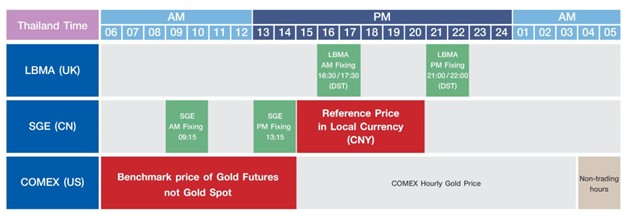
Despite the strength of Asia’s physical markets, one critical gap remains: the absence of a consistent, auditable gold reference price set during Asian trading hours. Most wholesale transactions in the region still reference London Bullion Market Association (LBMA) or COMEX benchmarks – prices set outside the region’s active hours and therefore less representative of regional liquidity patterns.
In addition, existing Asian‑hour reference prices are often denominated in local currencies, creating inconsistencies for an international market that predominantly prices gold in USD.
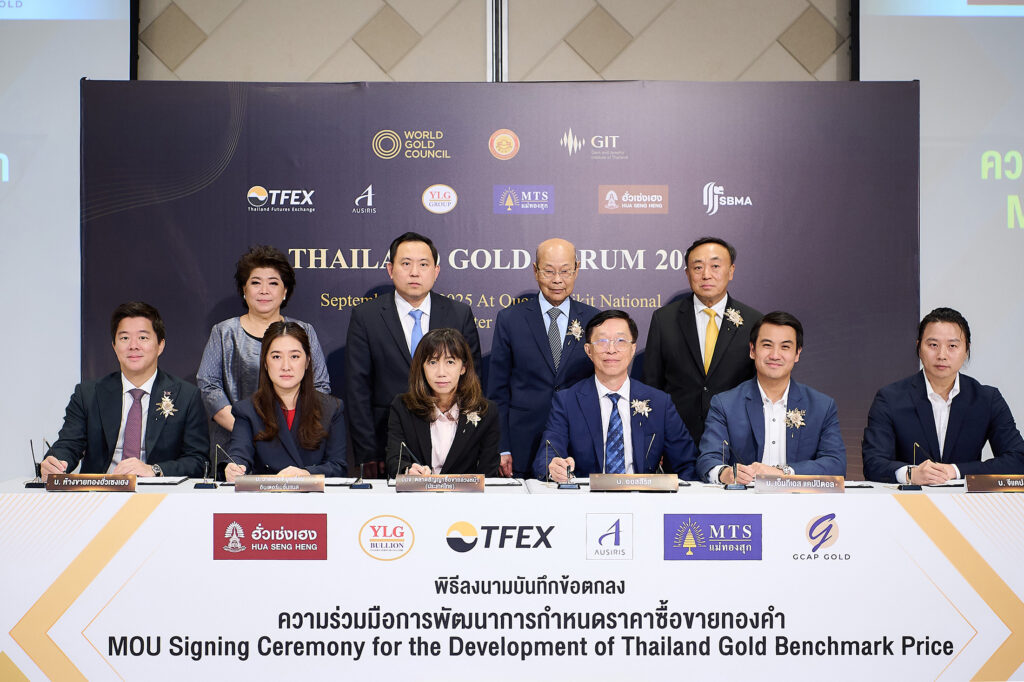
At the Thailand Gold Forum on 10 September 2025, TFEX, together with the Thailand Gold Traders Association and leading Thailand gold dealers, announced the development of the Thailand Gold Fixing Benchmark.
This initiative aims to provide a transparent, USD-denominated standardised reference price for wholesale gold, set during Asian trading hours. The benchmark will serve as the cornerstone of a more efficient, internationally aligned pricing mechanism, reducing reliance on benchmarks outside Asian hours, supporting domestic trades, better reflecting the supply-and‑demand dynamics of Asian markets.
Properly designed and governed, this fixing benchmark can anchor price discovery in Asian hours, complement existing global benchmarks, and support Thailand’s emergence as a regional trading hub.
MOU Signing Ceremony at Thailand Gold Forum 2025

Design, Governance & Phased Roll‑Out

The Thailand Gold Fixing Benchmark will feature regular AM and PM publications, expressed in USD per troy ounce for standard‑purity wholesale gold. Quotes will be collected from a group of approved market contributors through a standardised submission process, ensuring both consistency and fairness.

TFEX will be responsible for data submission, validation, and calculation under a transparent and auditable methodology that aligns with global best practices. Contributor identities will remain confidential, but anonymised disclosures may be published to reinforce market confidence.
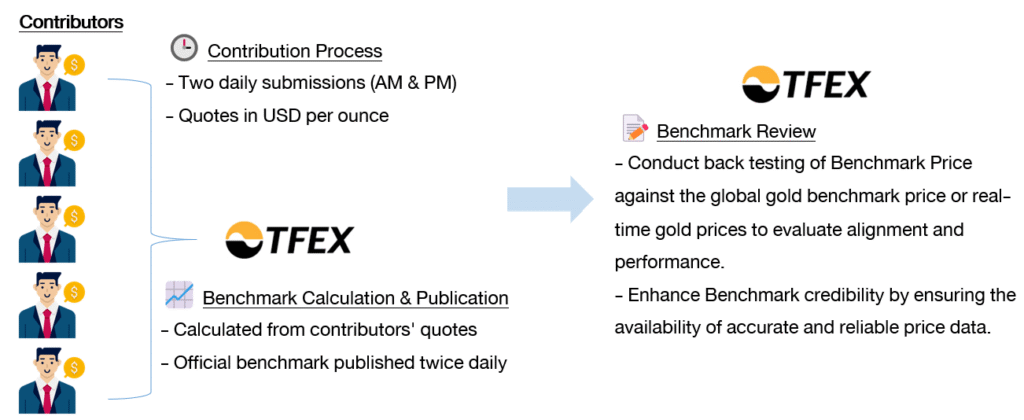
Strong governance underpins the initiative. Initial contributors will include major Thai import‑export houses and leading dealers, reflecting the country’s established gold trading base.
Over time, participation may broaden to include a wider set of regional and international contributors, further strengthening representativeness and reliability.
The development follows a deliberate, phased roadmap.
  • Phase 1: Establish the USD-denominated Thailand Gold Fixing and demonstrate stability and correlation with existing global benchmarks.
  • Phase 2: Integrate the benchmark into domestic wholesale transactions and develop financial products tied to it, including structured notes and futures contracts.
  • Phase 3: Encourage cross-border adoption, positioning the Thailand Gold Fixing as a broader regional benchmark used by market participants across Asia.

Why the Benchmark Matters

Alignment with Asian trading hours
A benchmark set during Asian working hours provides regional participants with a reliable pricing anchor when they are most active. This facilitates accurate inventory valuation, real‑time risk management, and efficient pricing during the trading day, reducing exposure to overnight volatility and improving liquidity across the market.
Catalysing product innovation
A trusted benchmark supports the development of new financial products – from exchange traded derivatives (ETDs), ETFs and structured products to new futures formats, a credible fixing enables innovation in hedging, investment, and distribution. Standardisation creates opportunities for institutional investors seeking exposure to Asian gold markets under globally accepted risk‑management frameworks.
Enhancing regional competitiveness
Developing benchmark infrastructure enhances Thailand’s position within Asia’s gold value chain. The initiative will reduce transaction and hedging costs, improve transparency, and foster greater participation from international institutions. Over time, it will deepen market liquidity and contribute to a more integrated regional bullion ecosystem.

Thailand’s Golden Future

Thailand’s gold market sits at an inflection point. Long-standing cultural affinity and substantial physical liquidity now converge with digital innovation and strategic infrastructure development. The creation of the Thailand Gold Fixing Benchmark represents a pivotal step towards a more transparent, connected, and globally relevant marketplace.
By aligning local strengths with international standards, Thailand is building the foundation for sustainable growth and a better-integrated regional ecosystem. As this benchmark gains traction, it is poised to enhance market transparency, strengthen investor confidence and reinforce Thailand’s role as a vital hub within Asia’s – and the world’s – precious metals ecosystem.
TANARAT PASAWONGSE, Chief Executive Officer of Hua Seng Heng Group, leads one of Thailand’s most respected precious‑metals institutions with more than 75 years of heritage. Under his leadership, Hua Seng Heng has evolved from a family‑run gold house into a technology‑driven leader, and has propelled Hua Seng Heng into a comprehensive precious-metals solutions provider, serving clients from domestic retail to international wholesale. The group also offers exchange brokerage service for gold futures trading. Tanarat also serves as a board director of the Thailand Gold Traders Association, contributing to shaping the nation’s gold-market strategy and the industry’s broader development.