Singapore Bullion Market Association

Article List

Article List

India’s Precious Metals Reset in 2025: Policy Alignment, Market Structure and the Consolidation of Trust

By SRINIVASA MOORTHY & PRATHIK TAMBRE, Research Desk, Bullion World

In 2025, India undertook a broad recalibration of its precious metals regulatory framework encompassing gold, silver and platinum group metals. Changes spanning trade classification, import access, collateralised lending, investment products and quality assurance amount to more than incremental reform. Taken together, they represent a structural realignment of market architecture, governance standards and regulatory coherence.

For international bullion market participants, developments in India signal a maturing policy approach in one of the world’s largest precious metals consuming and importing jurisdictions – one increasingly aligned with global norms, while remaining adapted to domestic scale and complexity.

Table 1: India Gold Supply (tonnes, fine gold basis)

India Gold Supply 2024 2025
Standard Gold Bullion 572.30 451.10
Dore (on fine gold basis) 229.40 212.60
Scrap 114.31 92.74
Domestic 17.74 14.71
Total 933.75 771.15

Note: Calendar year (January – December).  Source: World Gold Council

Trade Classification and Regulatory Consistency

A central element of the 2025 reform agenda was the alignment of India’s import policy with the ITC (HS) 2022 framework under Chapter 71, implemented through amendments in the Finance Act 2025. Subsequent notifications issued by the Directorate General of Foreign Trade (DGFT) during May and June 2025 provided greater clarity across tariff lines, import conditions and product definitions covering unwrought metals, alloys, semi-manufactured forms, jewellery and components.
Notably, certain precious metal alloys containing gold beyond defined thresholds were reclassified under the “Restricted” category, tightening licensing oversight and addressing long-standing ambiguities in classification. Complementary customs instructions were issued to ensure consistent interpretation at ports of entry.
In parallel, restrictions introduced on select categories of unstudded platinum jewellery reflected a more granular, definition-driven regulatory approach. Collectively, these measures were aimed at reducing interpretative discretion, strengthening compliance discipline and enhancing predictability for cross-border trade participants.

Chart 1: Gold Bullion/Dore Duties and Taxes
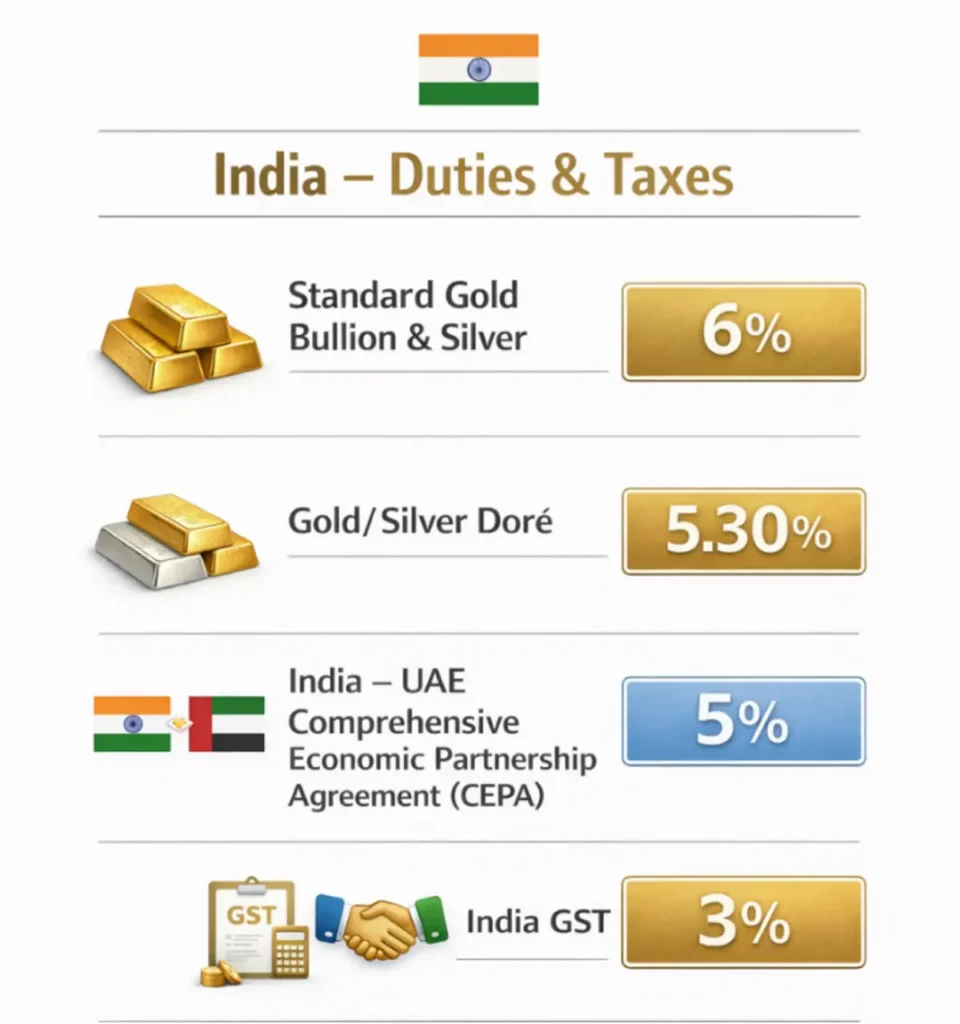
Note: Duty refers to Basic Custom Duty calculated on the tariff value announced by the government once a fortnight in USD/gm. GST is calculated on the invoice value in INR terms. Source: Finance Ministry, Government of India.

Import Access and Market Infrastructure

During 2025, India’s approach to bullion import access also evolved. Allocation of gold tariff-rate quotas (TRQs) under the India–UAE Comprehensive Economic Partnership Agreement (CEPA) transitioned to a competitive online bidding mechanism, replacing earlier allocation practices.
At the same time, regulatory coordination between the International Financial Services Centres Authority (IFSCA) and the India International Bullion Exchange (IIBX) enabled eligible participants to import bullion through an IFSC-based ecosystem integrating exchange trading, settlement, vaulting and logistics. This linkage of quota access with regulated market infrastructure represents a shift away from discretionary licensing towards a structured, transparent and auditable mechanism.
From an international perspective, the development aligns India’s bullion import framework more closely with the established exchange-centric models, with implications for custody standards, risk management and settlement integrity.

Chart 2: India Standard Gold Bullion – Country-Wise Import Share
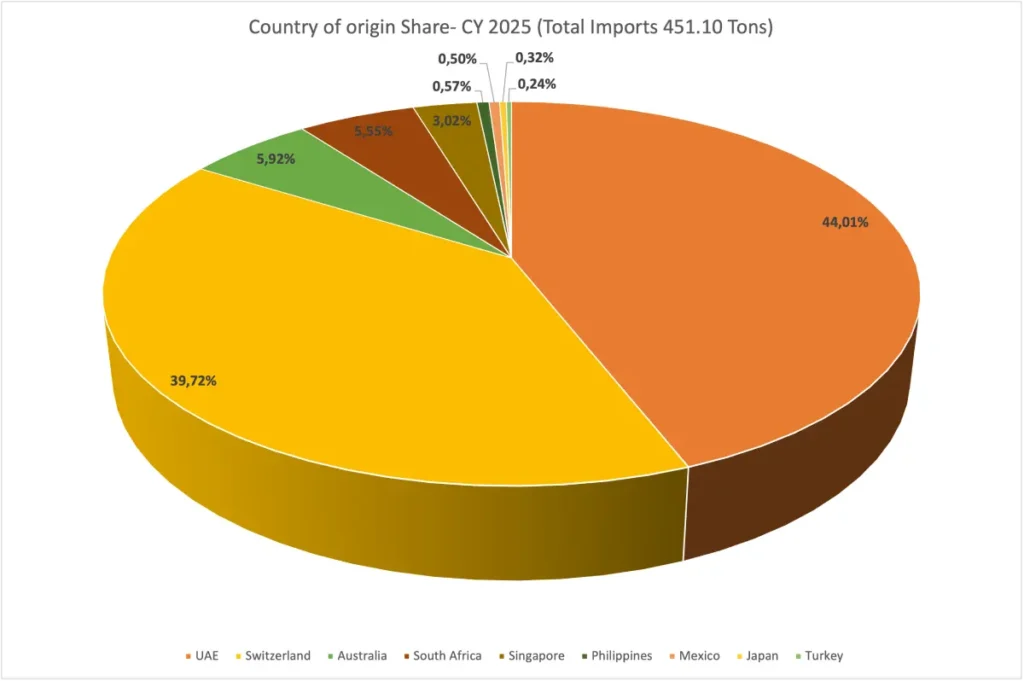
Note: Calendar year (January – December). Source: Ministry of Commerce, Government of India

Collateralised Lending and Formal Credit Integration

On the financing side, the Reserve Bank of India’s “Directions on Lending against Gold and Silver Collateral (2025)” represents a material formalisation of bullion-backed credit. For the first time, silver was explicitly recognised as eligible collateral, extending the regulatory framework beyond gold-centric lending.
The Directions introduced detailed standards covering valuation methodology, purity verification, custody, auction processes and timelines for collateral release. The inclusion of borrower compensation provisions in cases of delayed release strengthens accountability and consumer protection in a segment characterised by high transaction volumes.
Beyond governance considerations, the framework carries broader market implications, potentially improving access to formal credit for silver-holding MSMEs and jewellers and integrating bullion more closely into regulated lending channels.

Quality Assurance and Traceability

Quality assurance reforms have progressed in parallel. The Bureau of Indian Standards (BIS) initiated voluntary HUID -based hallmarking for silver under the revised IS 2112:2025 standard and expanded the scope of gold hallmarking to include 9-carat jewellery.
The emphasis on digital traceability, multiple fineness grades and strengthened enforcement reflects a systematic approach to formalisation across metals and price segments. Over time, these measures are expected to reduce information asymmetry, ensure consistent quality as promised, enhance consumer confidence and improve compatibility with international assaying and certification practices.

Investment Products and Price Discovery

Chart 3: India Gold and Silver ETFs
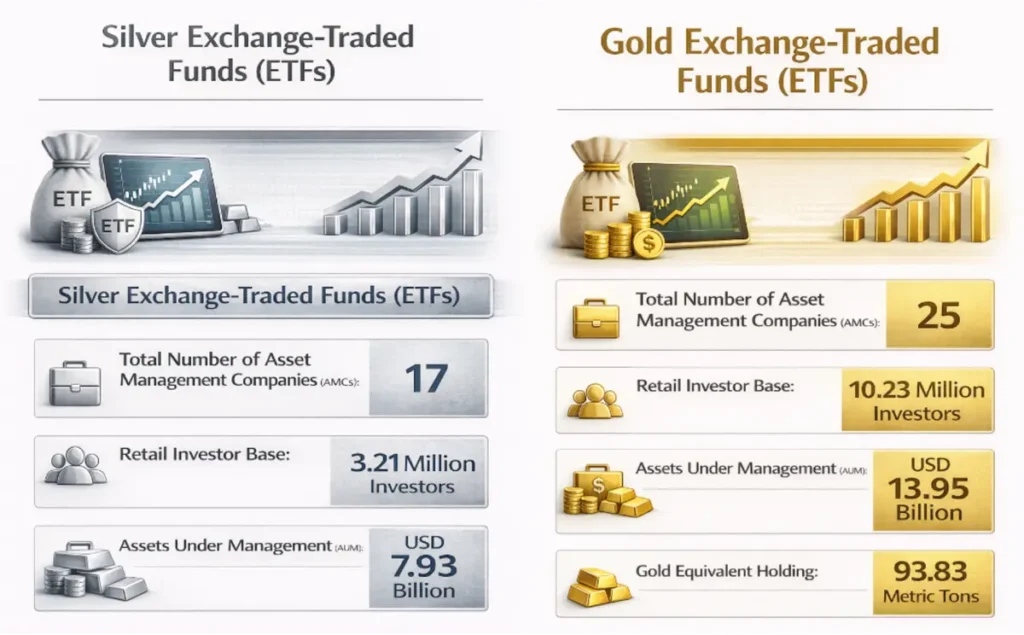
Note: Calendar year (January – December). Source: Ministry of Commerce, Government of India
Capital market oversight has evolved in step with the physical market reforms. The Securities and Exchange Board of India’s (SEBI) consultation on the potential use of domestic spot prices for gold and silver ETF valuation, points to a broader policy intent to anchor investment products more firmly to local price discovery.
Once implemented, such a shift would improve transparency in net asset value (NAV) calculation, reduce global-local price distortions and reinforce the credibility of domestic bullion benchmarks – an important consideration as gold and silver ETF participation deepens across retail and institutional segments.

Consolidation and the Road Ahead

Taken together, the year 2025 represents a year of consolidation for India’s precious metals policy and regulatory framework. Harmonised trade classification, structured import access, IFSC-based market infrastructure, formalised collateral lending, evolving investment products and strengthened hallmarking collectively signal a transition toward a more integrated, transparent and institutionally robust system.
For international bullion market participants, India’s reforms underscore the convergence between large consuming jurisdictions and global governance standard – an essential foundation for trust, liquidity and long-term market stability.
SRINIVASA MOORTHY is a content editor associated with Bullion World, a publication focused on the precious metals and bullion industry. He serves on the editorial team responsible for shaping and curating content across editions of the magazine, contributing to industry analysis, market commentary, and editorial oversight.
PRATHIK TAMBRE is a financial and precious-metals market professional associated with Bullion World, where he serves as a senior analyst for precious metals. He is also affiliated with Eventell Global Advisory Private Limited, contributing to in-depth market research, advisory initiatives, and content development across the commodities and financial markets ecosystem.